King Coconut
King Coconut Nutrition Facts: The Complete Breakdown
Updated:
Key Takeaways
King coconut water provides approximately 250 mg potassium per 100 ml (Coconut Research Institute of Sri Lanka) — roughly 67% more than regular green coconut water. Its osmolality of 289 mOsm/kg sits within the isotonic range. All numbers cited.
TL;DR
King coconut water contains approximately 250 mg of potassium per 100 ml (Coconut Research Institute of Sri Lanka) [1] — higher than regular green coconut water (~150 mg) and Gatorade (~12 mg, manufacturer data). A DPPH radical scavenging assay at the University of Jaffna (2024) measured a higher polyphenol content in king coconut water than in other coconut varieties tested [2]. Energy density: approximately 20 kcal per 100 ml, with natural fruit sugar only — no added sugar. All figures below are cited.
The nutrition table
| Per 100 ml | King Coconut Water | Regular Coconut Water | Gatorade |
|---|---|---|---|
| Calories | ~20 kcal | ~19 kcal | ~25 kcal |
| Potassium | ~250 mg | ~150 mg | ~12 mg |
| Sodium | ~25 mg | ~20 mg | ~45 mg |
| Magnesium | ~6 mg | ~5 mg | ~0 mg |
| Sugar | ~4 g (natural) | ~3.5 g (natural) | ~6 g (added) |
| Added sugar | 0 g | 0 g | 6 g |
Sources: Coconut Research Institute of Sri Lanka [1], USDA FoodData Central, Gatorade manufacturer data.
How much potassium is in king coconut water?
Approximately 250 mg per 100 ml, as documented by the Coconut Research Institute of Sri Lanka [1]. That is the highest potassium concentration recorded among commercially measured coconut water varieties.
For context: a medium banana contains around 422 mg of potassium across 118 g of fruit. A single 330 ml serving of king coconut water provides approximately 825 mg — close to double the potassium content of a banana on a per-serving basis.
Germany's DGE (Deutsche Gesellschaft für Ernährung) sets a daily reference value of 4,000 mg potassium for adults [3]. A 330 ml serving of king coconut water corresponds to roughly 20% of that reference.
Why the higher potassium? King coconut (Cocos nucifera var. aurantiaca) grows on the red laterite soils of Sri Lanka. The Coconut Research Institute has documented over decades that this variety consistently shows higher potassium values than Cocos nucifera cultivars from other growing regions [1].
King coconut vs. sports drinks — the numbers
The table above lists the measured values side by side. Per 100 ml, king coconut water contains roughly 250 mg potassium vs. Gatorade's ~12 mg (manufacturer data), with approximately 44% less sodium and no added sugar.
In a 2012 study published in the Journal of the International Society of Sports Nutrition, Kalman et al. compared coconut water with a carbohydrate-electrolyte sports drink in a post-exercise rehydration protocol. The researchers reported comparable rehydration performance between the two, with coconut water associated with fewer self-reported gastrointestinal complaints [4].
Sodium content in king coconut water sits at approximately 25 mg per 100 ml. Sports drinks typically deliver 45-52 mg per 100 ml. The appropriate sodium intake depends on the activity and the individual — a question best answered by a qualified nutritionist, not a bottle label.
Polyphenol content: what the research measured
A 2024 DPPH radical scavenging assay at the University of Jaffna measured a higher polyphenol content in king coconut water than in the other Sri Lankan coconut varieties tested [2]. DPPH is a standard method in food chemistry for quantifying the reducing capacity of a sample — a chemistry measurement, not a health claim.
The study reported a total phenolic content expressed as 403.73 mg GAE/ml for king coconut water samples, above the values measured for regular green and mature coconut varieties [2]. These numbers describe laboratory findings on plant chemistry.
EU food law does not permit general "antioxidant" health claims for foods without a specific authorised nutrient basis. We therefore report the chemistry measurement only — without extrapolating to consumer benefits.
Why the colour matters
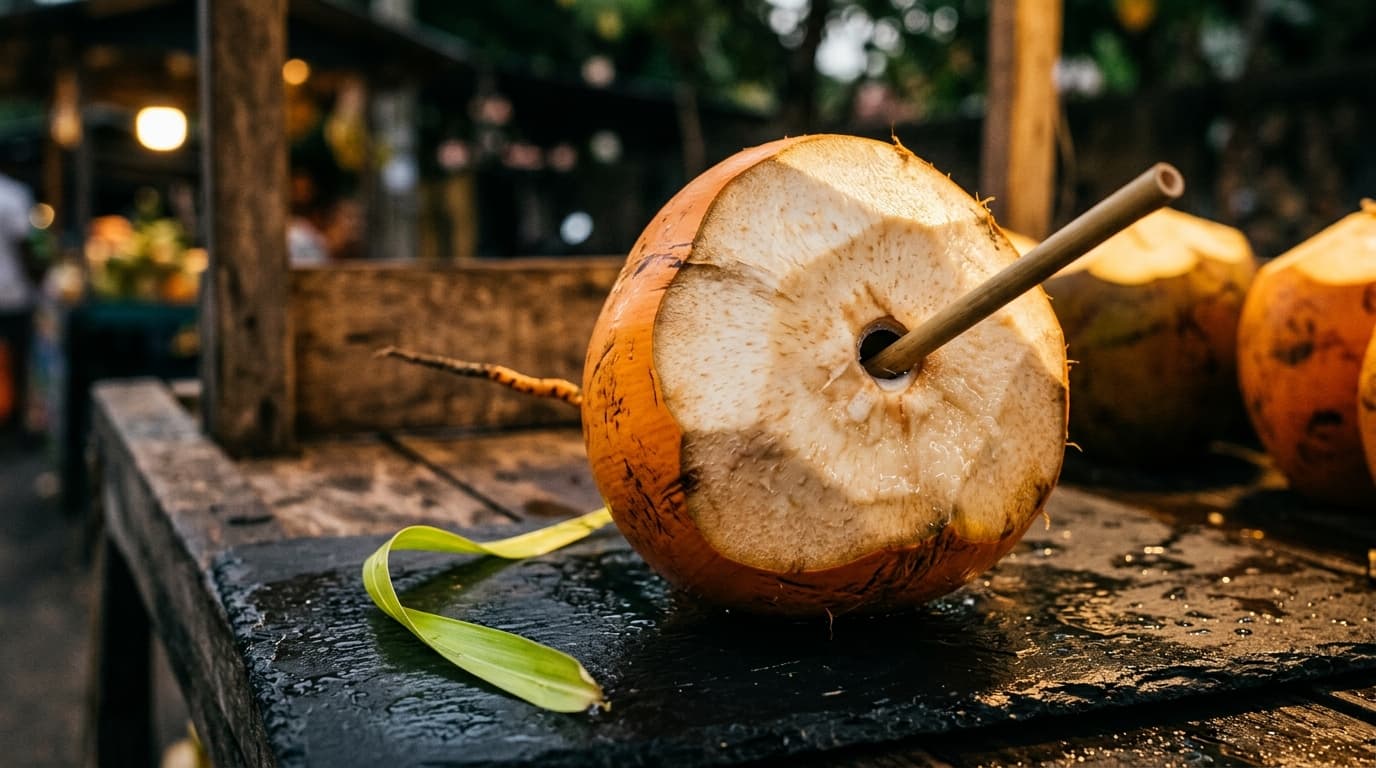
King coconut glows golden-orange. Not because someone painted it, but because it contains carotenoids — the same compound class found in carrots and tomatoes.
Carotenoids are secondary plant metabolites. Their concentration in the husk is a visual marker of the variety: regular green coconuts do not share this pigment profile [2]. The colour is a varietal identifier, not a consumer health claim.
Osmolality: within the isotonic range
King coconut water has an osmolality of 289 mOsm/kg [5]. The isotonic range is generally defined as 275-295 mOsm/kg.
This measurement comes from a 2017 study at the University of Sri Jayewardenepura on the physicochemical properties of king coconut water [5]. It is a descriptive chemistry measurement. It is not a medical or therapeutic claim.
20 kcal. 250 mg potassium. 289 mOsm/kg. No added sugar. These are the measured values. What you do with them is your choice.
Sources
- Coconut Research Institute of Sri Lanka — Varietal nutrient composition data, king coconut (Cocos nucifera var. aurantiaca)
- University of Jaffna (2024) — DPPH radical scavenging assay, antioxidant capacity of Sri Lankan coconut varieties
- Deutsche Gesellschaft für Ernährung (DGE) — Reference value for potassium intake, 4,000 mg/day for adults
- Kalman, D.S. et al. (2012) — "Comparison of coconut water and a carbohydrate-electrolyte sport drink on measures of hydration and physical performance in exercise-trained men." Journal of the International Society of Sports Nutrition, 9:1. PMC 3293068
- Prapitiya, L. et al. (2017) — Osmolality and electrolyte composition of king coconut water. University of Sri Jayewardenepura, Sri Lanka
Small. Real. Gold.
FAQ
King coconut water contains approximately 250 mg of potassium per 100 ml (Coconut Research Institute of Sri Lanka). By comparison, regular coconut water contains around 150 mg and Gatorade approximately 12 mg per 100 ml (manufacturer data).
Its osmolality was measured at 289 mOsm/kg at the University of Sri Jayewardenepura (2017), which falls within the isotonic range of 275-295 mOsm/kg. This is a descriptive chemistry measurement, not a health claim.
No. King coconut water contains only naturally occurring fruit sugars, approximately 4 g per 100 ml. Gatorade, by comparison, contains around 6 g of sugar per 100 ml, all added.
PONDI
Editorial
PONDI brings King Coconut Water and Ceylon Vanilla from Sri Lanka to Germany — researched, verified, straight from the island.
Read More
New posts delivered to your inbox
No spam. Just knowledge.