King Coconut
King Coconut vs. Coconut Water — What's the Difference?
Updated:
Key Takeaways
King coconut water comes from Cocos nucifera var. aurantiaca — a distinct botanical variety cultivated almost exclusively in Sri Lanka. It contains approximately 250 mg potassium per 100 ml (Coconut Research Institute of Sri Lanka), roughly 67% more than regular green coconut water.
King coconut water comes from a distinct botanical variety — Cocos nucifera var. aurantiaca — cultivated almost exclusively in Sri Lanka. The measurements below show how it differs from regular green coconut water in potassium content, polyphenol content, and osmolality.
What is king coconut?
Most coconut water brands in supermarkets use green coconuts (Cocos nucifera). These come from Thailand, the Philippines, or Brazil.
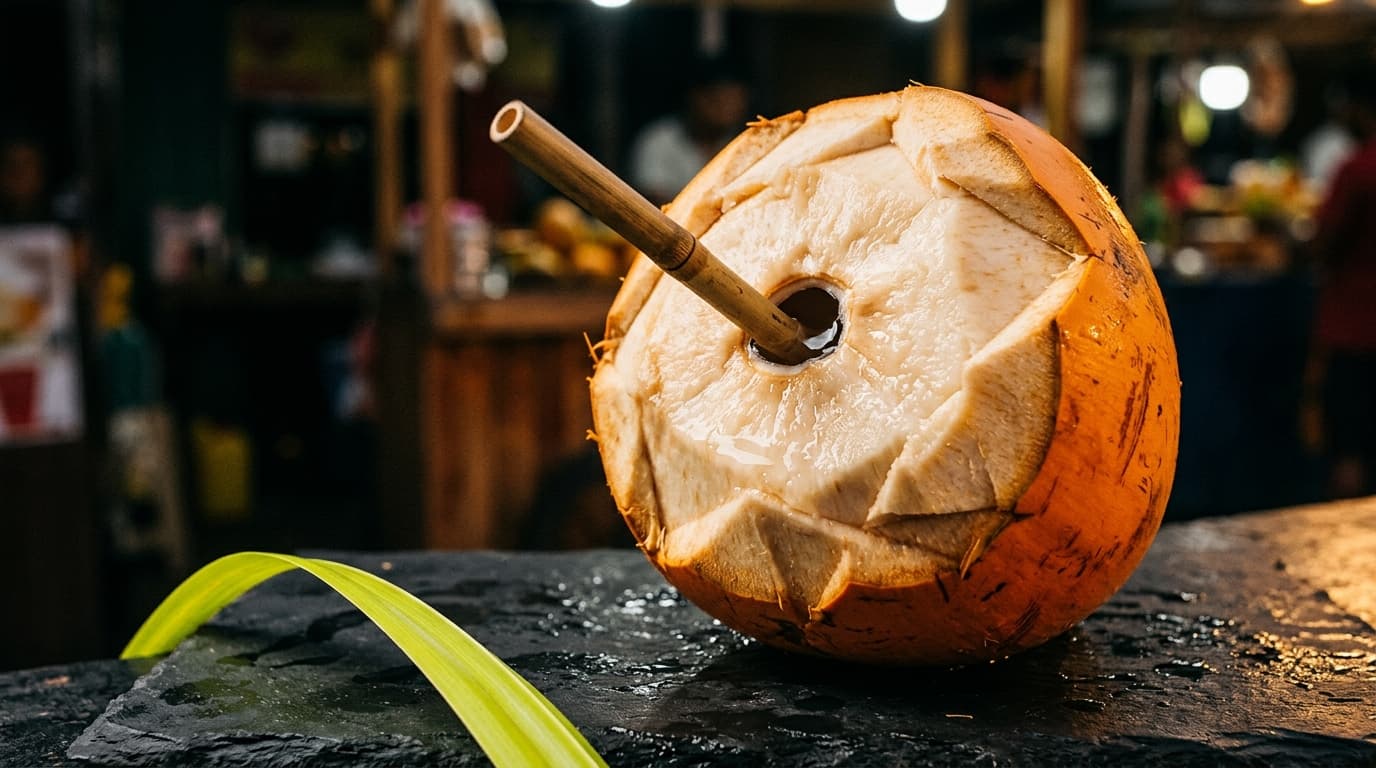
King coconut looks different. You recognise it by its bright golden-orange husk. In Sri Lanka it is called Thambili and has been cultivated for generations for its drinking water rather than its flesh, milk, or oil.
The numbers compared
| Property | King Coconut Water | Regular Coconut Water |
|---|---|---|
| Potassium (per 100 ml) | ~250 mg [1] | ~150 mg |
| Polyphenol content (DPPH assay) | Higher in tests [2] | Lower |
| Added sugar | 0 g | 0 g (usually) |
| Osmolality | 289 mOsm/kg [3] | Varies |
| Commercial origin | Sri Lanka | Thailand, Philippines, Brazil |
Sources: [1] Coconut Research Institute of Sri Lanka. [2] University of Jaffna, 2024 — DPPH assay of Sri Lankan coconut varieties. [3] University of Sri Jayewardenepura, 2017.
Why it tastes different
King coconut tastes naturally sweeter than regular green coconut water — without any added sugar. The sweetness comes from the variety itself: the natural sugar and aroma balance in Cocos nucifera var. aurantiaca differs from other Cocos nucifera cultivars.
The result: a fuller, rounder flavour with gentle natural sweetness. Genetics, not syrup.
Sri Lankan origin — what the supply chain looks like
King coconut is strongly associated with Sri Lanka. Commercial production is concentrated there, and the variety has been cultivated on the island for generations. Attempts to establish commercial plantations in other countries have not produced significant volumes, which is why essentially all king coconut water in European shops is sourced from Sri Lanka.
The combination of red laterite soil, tropical monsoon climate, and coastal proximity is the environment in which the variety has been grown for centuries. It is not exclusive to Sri Lanka in the strict botanical sense, but the commercial supply chain effectively is.
Osmolality within the isotonic range
A 2017 study at the University of Sri Jayewardenepura reported an osmolality of 289 mOsm/kg for king coconut water [3]. The isotonic range is usually defined as 275-295 mOsm/kg. This is a descriptive chemistry measurement, not a health or therapeutic claim.
For context: a 330 ml serving contains approximately 825 mg potassium. A medium banana contains around 422 mg on 118 g of fruit weight. On a per-serving basis, king coconut water delivers roughly double the potassium of a banana.
One ingredient, one origin, one variety
King coconut water is a different product than commodity coconut water — a different variety, a different supply chain, a different flavour profile. The measurements describe the chemistry; the taste is your own test.
PONDI brings king coconut water from Sri Lanka to Germany.
FAQ
King coconut water comes from Cocos nucifera var. aurantiaca — a distinct botanical variety cultivated almost exclusively in Sri Lanka. It contains approximately 250 mg potassium per 100 ml (Coconut Research Institute of Sri Lanka), compared to around 150 mg in regular green coconut water. A 2024 DPPH assay at the University of Jaffna measured a higher polyphenol content in king coconut water than in the other coconut varieties tested.
King coconut has been cultivated in Sri Lanka for generations and is best known as a Sri Lankan variety. Its commercial production sits almost entirely on the island, associated with red laterite soils and a tropical monsoon climate. It is not exclusive to Sri Lanka in the strict botanical sense, but the commercial supply chain is.
Its osmolality was measured at 289 mOsm/kg at the University of Sri Jayewardenepura (2017), which falls within the isotonic range of 275-295 mOsm/kg. This is a descriptive chemistry measurement, not a health claim. A 330 ml serving contains approximately 825 mg potassium, close to double the potassium content of a medium banana (~422 mg).
PONDI
Editorial
PONDI brings King Coconut Water and Ceylon Vanilla from Sri Lanka to Germany — researched, verified, straight from the island.
Read More
New posts delivered to your inbox
No spam. Just knowledge.