King Coconut
What Is King Coconut? The Golden Coconut from Sri Lanka
Updated:
Key Takeaways
King coconut (Cocos nucifera var. aurantiaca) is a distinct botanical variety of coconut, cultivated almost exclusively in Sri Lanka. It stands apart from other commercial coconut varieties through its golden-orange husk and a measurably higher potassium content.
King Coconut -- the Short Answer
King coconut (Cocos nucifera var. aurantiaca) is a distinct botanical variety of coconut, cultivated almost exclusively in Sri Lanka. It stands apart from other commercial coconut varieties through its golden-orange husk and a measurably different nutrient profile.
The measurements: a 2024 DPPH assay at the University of Jaffna reported a total phenolic content of 403.73 mg GAE/ml for king coconut water samples, above the values measured for the other Sri Lankan coconut varieties tested [1]. Potassium content sits at approximately 250 mg per 100 ml (Coconut Research Institute of Sri Lanka). Gatorade contains around 12 mg per 100 ml (manufacturer data).
In Sri Lanka, it is called Thambili. It has been cultivated for generations specifically for its drinking water, not for flesh, milk, or oil.
Quick Facts
| Property | Detail | Source |
|---|---|---|
| Botanical name | Cocos nucifera var. aurantiaca | Jayasinghe & Hewajulige, 2021 |
| Commercial origin | Sri Lanka (cultivated almost exclusively on the island) | Coconut Research Institute, Sri Lanka |
| Husk colour | Golden-orange | -- |
| Potassium | ~250 mg / 100 ml | Coconut Research Institute; Marapana et al., 2017 |
| Total phenolic content (DPPH assay) | 403.73 mg GAE/ml | University of Jaffna, 2024 |
| Osmolality | 289 mOsm/kg (within isotonic range) | University of Sri Jayewardenepura, 2017 |
| Cultivation history | Cultivated for generations for drinking water | Jayasinghe & Hewajulige, 2021 |
| Local name | Thambili (Sinhala) | -- |
Why Is It Called "King" Coconut?
Because it has long held a special place in Sri Lankan culture — traditionally offered to guests and used in ceremonies. While other coconuts are grown for oil, milk, or flesh, king coconut was cultivated over generations specifically for its drinking water (Jayasinghe & Hewajulige, 2021).
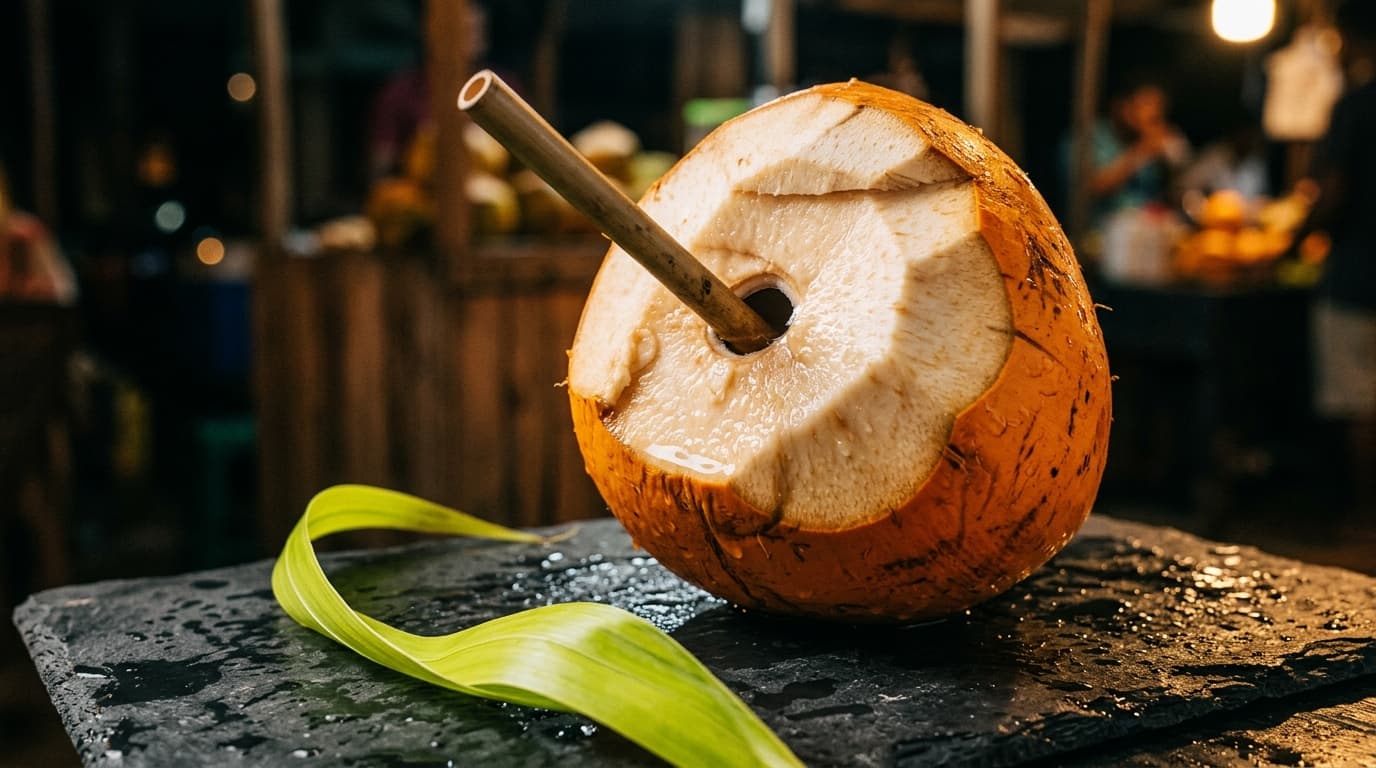
The fruit has a golden-orange husk, and the water inside is naturally sweeter than regular green coconut water. No sugar added — the sweetness comes from the variety itself.
What Is Thambili?
Thambili (pronounced: TAHM-bi-li) is the Sinhala word for king coconut. At roadside stalls, beach stands, and village shops across Sri Lanka, it is a common refreshment offered to guests.
Here is how it works: a vendor strikes the top off the orange nut with a machete. You drink straight from the fruit. Cold, fresh, unprocessed. Sri Lanka is a major coconut producer, and king coconut represents a distinct varietal segment within that production.
The Golden-Orange Colour -- Where Does It Come From?
The colour is the most visible identifier. While common green coconuts carry green, brown, or yellowish husks, king coconut's husk is golden-orange. This comes from a higher carotenoid content in the outer shell — the same compound class found in carrots and tomatoes.
The colour is a varietal marker, not a health claim. King coconut reaches optimal harvest at 7 to 8 months on the tree, the window documented as having peak water content and flavour development (Jayasinghe et al., 2023, Coconut Research Institute).
Where Does King Coconut Grow?
King coconut is cultivated almost exclusively in Sri Lanka. Commercial production sits on the island, associated with red laterite soils and a tropical monsoon climate. Attempts to establish commercial plantations in other countries have not produced significant volumes, which is why essentially all king coconut water in European shops is sourced from Sri Lanka.
It is not strictly endemic in the botanical sense, but the commercial supply chain effectively is. Thailand, the Philippines, and Brazil grow other coconut varieties — not king coconuts.
How Is King Coconut Different from Green Coconut?
The measured differences:
| Property | King Coconut | Green Coconut | Source |
|---|---|---|---|
| Potassium | ~250 mg / 100 ml | ~150 mg / 100 ml | Coconut Research Institute; Marapana et al., 2017 |
| Total phenolic content (DPPH assay) | 403.73 mg GAE/ml | Lower in tests | University of Jaffna, 2024 |
| Natural sugar | ~5.0 Brix | ~3.0-4.5 Brix | Jayasinghe & Hewajulige, 2021 |
| Husk colour | Golden-orange | Green | -- |
| Commercial origin | Sri Lanka | Thailand, Philippines, Brazil, etc. | -- |
| Osmolality | 289 mOsm/kg (within isotonic range) | Varies | Marapana et al., 2017 |
Laboratory characterisations have identified amino acids, phenolic compounds, and other secondary metabolites in king coconut water (ScienceDirect, 2024). These are descriptive chemistry findings. EU food law does not permit general "antioxidant" health claims for foods without reference to a specifically authorised nutrient.
How Is King Coconut Harvested and Consumed?
By hand. King coconut palms grow up to 30 metres tall. Harvesters climb the trunks, detach ripe fruit by hand, and lower them in baskets.
The optimal harvest window is 7 to 8 months of maturity. Harvested too early, the water lacks sweetness. Too late, and the composition shifts. The Coconut Research Institute of Sri Lanka has documented this window (Jayasinghe et al., 2023).
The traditional way to drink it: crack the top open with a machete, drink straight from the fruit. Cold, fresh, unprocessed. The University of Sri Jayewardenepura (2017) measured an osmolality of 289 mOsm/kg for king coconut water — within the isotonic range, as a descriptive chemistry measurement.
King of Coconuts
A distinct coconut variety, cultivated for generations specifically for its drinking water, almost exclusively on Sri Lanka. Measurably higher potassium content than green coconut water, higher polyphenol content in published DPPH assays, and a golden-orange husk that sets it apart visually.
King of coconuts. From Sri Lanka.
Sources
- University of Jaffna (2024) -- Antioxidant Activity of Different Coconut Varieties. Food Chemistry Advances, ScienceDirect. Link
- Marapana et al. (2017) -- King Coconut as Isotonic Sports Beverage. Journal of Pharmacognosy and Phytochemistry, 5(5). Link
- Jayasinghe & Hewajulige (2021) -- The Golden Nut of Sri Lanka. Sri Lanka Journal of Food and Agriculture, 7(1). Link
- Jayasinghe et al. (2023) -- Compositional Changes During Maturation. Journal of the National Science Foundation of Sri Lanka, 51(2). Link
- Coconut Research Institute of Sri Lanka — Varietal nutrient composition data, king coconut (Cocos nucifera var. aurantiaca)
FAQ
King coconut is cultivated almost exclusively in Sri Lanka. Commercial production sits on the island, associated with red laterite soils and a tropical monsoon climate. It is not strictly endemic in the botanical sense, but the commercial supply chain effectively is.
Thambili is pronounced TAHM-bi-li, with emphasis on the first syllable. It is the Sinhala word for king coconut — Sri Lanka's most popular street drink.
King coconut has a golden-orange husk instead of a green one. It contains approximately 250 mg potassium per 100 ml (Coconut Research Institute of Sri Lanka), compared to about 150 mg in regular green coconut water. A 2024 DPPH assay at the University of Jaffna measured a higher polyphenol content in king coconut water than in the other Sri Lankan coconut varieties tested.
PONDI
Editorial
PONDI brings King Coconut Water and Ceylon Vanilla from Sri Lanka to Germany — researched, verified, straight from the island.
Read More
New posts delivered to your inbox
No spam. Just knowledge.