Vanilla
Real Vanilla vs. Vanillin: How to Tell the Difference
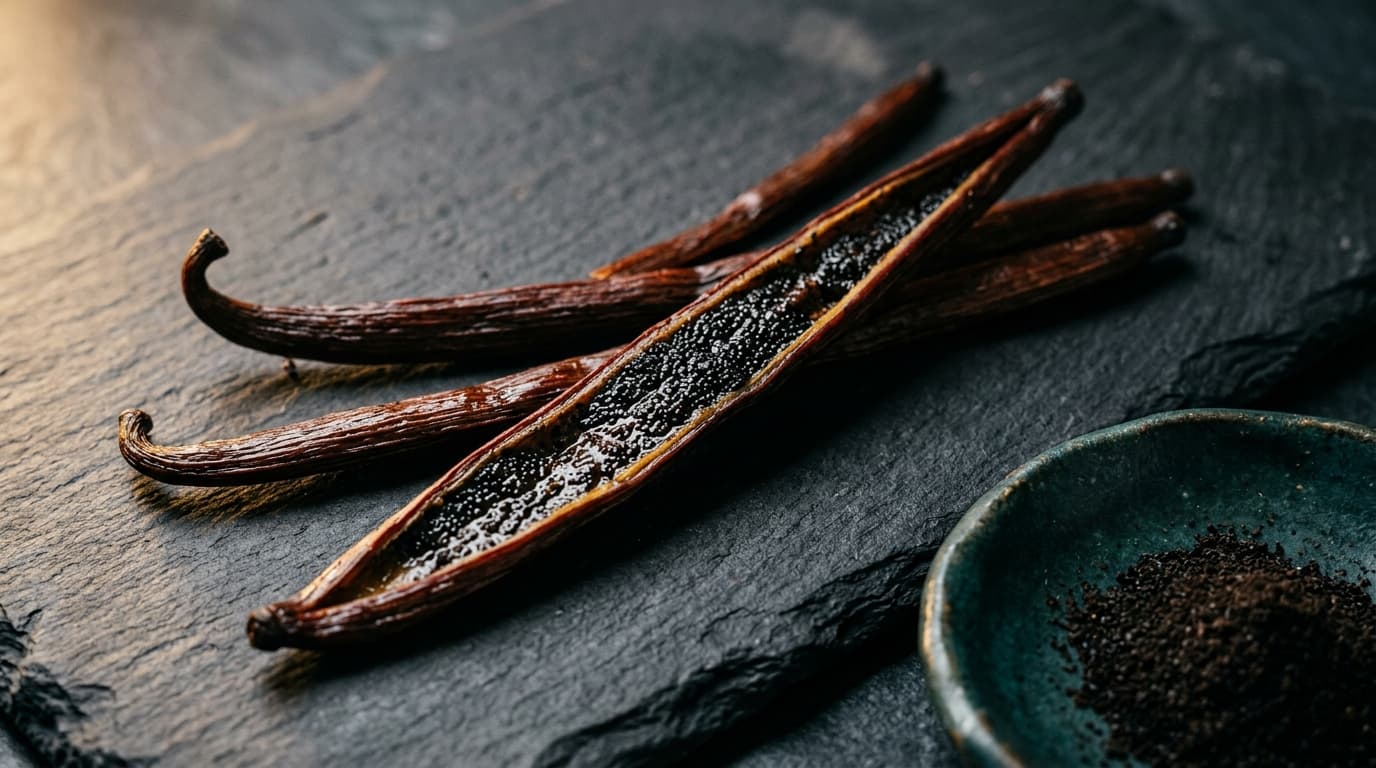
Key Takeaways
Real vanilla contains over 200 aroma compounds — including vanillin, p-hydroxybenzaldehyde, vanillic acid, and dozens of floral notes. Synthetic vanillin contains exactly one of them.
TL;DR
Real vanilla contains over 200 aroma compounds — including vanillin, p-hydroxybenzaldehyde, vanillic acid, and dozens of floral notes. Synthetic vanillin contains exactly one of them. Around 95% of the world's vanilla flavoring is synthetic, made from lignin or guaiacol [1]. The difference shows up in three places: the ingredient list, the smell, and the taste. Your nose knows the difference before your brain does. Here is what to look for.
What is vanillin?
Vanillin (4-hydroxy-3-methoxybenzaldehyde) is a single molecule. It is the dominant aroma compound in real vanilla pods — but just one of over 200 [2].
Synthetic vanillin is made in two ways: from lignin, a waste product of the wood and paper industry, or from guaiacol, a petrochemical feedstock [1]. Both processes yield a chemically identical molecule. Identical in the lab. Not identical on the tongue.
The economics explain the market: synthetic vanillin costs between EUR 0.01 and 0.05 per gram. A real vanilla pod costs EUR 4 to 8. That is why roughly 95% of the global food industry uses the synthetic version [1].
200 flavors against one
Real vanilla is not a single taste. It is an orchestra.
Beyond vanillin, the pod contains p-hydroxybenzaldehyde, vanillic acid, anisaldehyde, and over 200 other compounds [2]. Together, they produce what flavor chemists call "complexity": floral, woody, spicy, and slightly smoky notes that shift when heated.
Synthetic vanillin delivers exactly one dimension of that: sweet. One-dimensionally sweet. Like a piano with a single key.
| Real Vanilla | Vanillin (synthetic) | Vanilla Extract | |
|---|---|---|---|
| Aroma compounds | 200+ | 1 | 50-100 |
| Source | Vanilla orchid | Lignin / guaiacol | Vanilla orchid (extracted) |
| Taste | Complex, floral, spicy | One-dimensional sweet | Medium, alcoholic |
| Price | EUR 4-8 / pod | EUR 0.01-0.05 / g | EUR 3-6 / 50 ml |
| Use | Desserts, pastry, ice cream | Industrial products | Baking, drinks |
How to read the ingredient list
Food labeling rules are precise — if you know where to look.
- "Vanilla" or "vanilla bean": Real. From the pod.
- "Vanillin": Synthetic. A single molecule from the lab.
- "Vanilla flavoring": Synthetic. Artificially produced.
- "Natural vanilla flavor": Caution. Under EU regulation (EC) No 1334/2008, "natural" can also mean: fermentatively derived from rice husks or clove oil [3]. Not necessarily from the vanilla pod. US FDA rules are similarly permissive.
The only guarantee of real vanilla is the word "vanilla" or "vanilla bean" on the ingredient list. Everything else is interpretation.
The smell test
Real vanilla smells warm, complex, and slightly floral. The longer you smell a pod, the more layers you detect — tobacco, caramel, dark fruit, sometimes leather.
Synthetic vanillin smells immediately sweet. Flat. After three seconds, you have captured everything. There is no second layer.
The difference is so clear that perfumers identify it blindfolded. Your nose knows the difference before your brain does — because real vanilla activates over 200 molecules simultaneously, while vanillin triggers just a single receptor pathway [2].
Why Ceylon vanilla is even more complex
Not all real vanilla is equal. Vanilla planifolia from Madagascar (Bourbon vanilla) dominates the global market. Ceylon vanilla grows under different conditions: tropical-humid climate, volcanic soils, hand-pollination on smallholder farms.
The result: a flavor profile that aroma chemists describe as particularly layered — with stronger floral and spicy notes than Bourbon vanilla [4]. Production is tiny: Sri Lanka produces roughly 1.5 tonnes per year, against a global demand of over 3,000 tonnes [5].
Read more in our Ceylon vanilla deep dive.
The real cost
Vanilla is the second most expensive spice in the world after saffron. The reason is biology, not marketing.
Each vanilla flower opens for a maximum of 24 hours. Within that window, it must be hand-pollinated — outside Mexico, there is no natural pollinator [6]. After pollination, the pods ripen for nine months on the vine. Then come months of drying and fermentation.
A vanilla farmer produces in one year what a factory makes in synthetic vanillin in minutes. That is exactly why the price gap exists: EUR 4 to 8 per pod versus EUR 0.01 per gram of synthetic. The price reflects the effort — not the margin.
Sources
- Havkin-Frenkel, D. & Belanger, F.C. (2018) — Handbook of Vanilla Science and Technology. Wiley-Blackwell. Synthetic vanillin market share: ~95%
- Sinha, A.K. et al. (2008) — "Vanilla planifolia: an important spice with multiple uses." Medicinal and Aromatic Plant Science and Biotechnology, 2(2), 96-114. Aroma profile: 200+ compounds
- EU Regulation (EC) No 1334/2008 on flavorings and certain food ingredients with flavoring properties
- De Silva, M. et al. (2020) — Aromatic profile comparison of Sri Lankan vanilla cultivars. University of Peradeniya
- International Trade Centre (ITC) — Export data Sri Lanka vanilla, annual production ~1.5 tonnes
- Bory, S. et al. (2008) — "Natural pollination of Vanilla and its relationship with diversity." Genetic Resources and Crop Evolution, 55(3), 379-392
The vanilla that tastes like more. Rare. Intense. Real.
FAQ
No. Vanillin is just one of over 200 aroma compounds in real vanilla. Synthetic vanillin is made from lignin (wood waste) or guaiacol (petrochemical). Around 95% of the world's vanilla flavoring is synthetic — not from the vanilla pod.
Look for the exact wording. 'Vanilla' or 'vanilla bean' means real vanilla. 'Vanillin' or 'vanilla flavoring' is synthetic. 'Natural vanilla flavor' can legally come from sources other than vanilla beans, including rice husks or clove oil.
Every vanilla flower must be hand-pollinated within a 24-hour window. The pods ripen for nine months on the vine, followed by months of drying. Global demand exceeds 3,000 tonnes per year while supply remains tiny. Vanilla is the second most expensive spice after saffron.
PONDI
Editorial
PONDI brings King Coconut Water and Ceylon Vanilla from Sri Lanka to Germany — researched, verified, straight from the island.
Read More
New posts delivered to your inbox
No spam. Just knowledge.